


9boxmusic
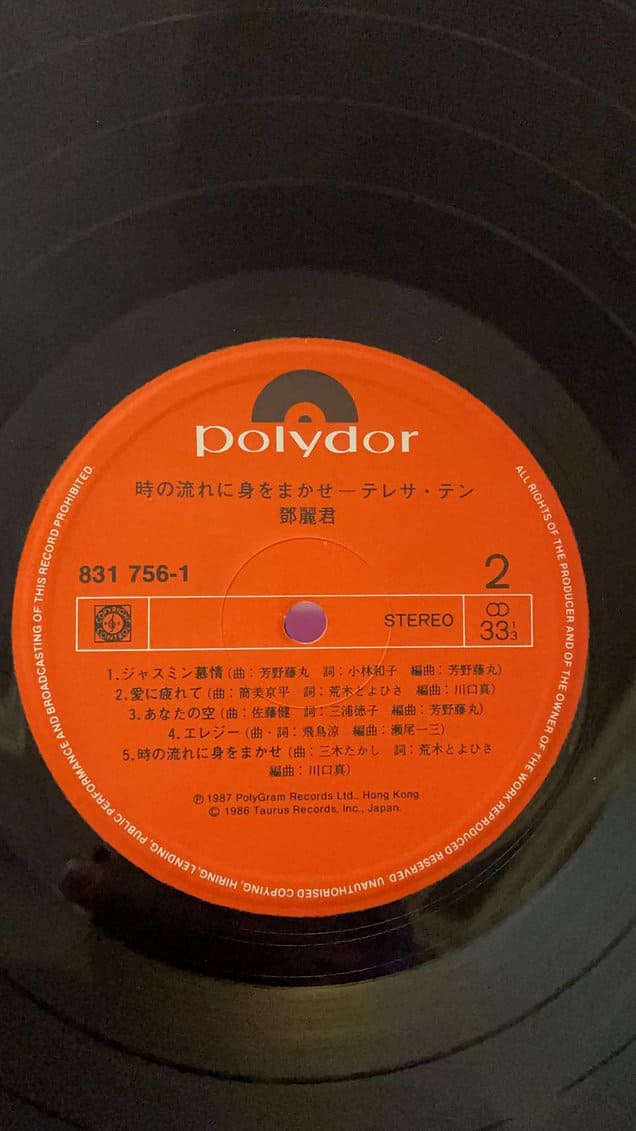
Recycling Teresa Teng's Time Flow (with the passage of time) Japanese album vinyl record Teresa Teng LP
Recycling Teresa Teng's Time Flow (with the passage of time) Japanese album vinyl record Teresa Teng LP
For collectors passionate about out-of-print 80s Japanese vinyl records, Teresa Teng's pressings from her Taurus era have always been highly regarded by the industry and audiophiles alike. Compared to modern reissues, the Taurus first-edition vinyl records from back then delivered a more delicate and authentic dynamic range and vocal warmth. This album is not just a pop music record; it's a historical soundtrack that captures Teresa Teng at the peak of her career in Japan. Due to its age and the high consumption volume back then, a Japanese-edition Teresa Teng vinyl record in excellent condition is incredibly rare in today's second-hand vinyl record market, making it a coveted dream item for serious music enthusiasts.
《時の流れに身を任せる》 (As Time Flows By) is a very famous Japanese song sung by Teresa Teng, released on February 21, 1986. The lyrics were written by Toyohisa Araki, the music composed by Takashi Miki, and arranged by Makoto Kawaguchi. It was included in the single EP of the same name, released by Taurus Records in Japan.
After its release, this song topped the Japanese Oricon Singles Chart for half a year, setting a new historical record. With this song, Teresa Teng won the All Japan Request Awards and the Japan Cable Awards for the third consecutive time. Following "Tsugunai" in 1984 and "Aijin" in 1985, it became her third annual champion song since her return to the Japanese music scene, achieving an unprecedented "double award three-peat" record in Japanese music history.
In 1998, "Toki no Nagare ni Mi wo Makase" was selected as one of the "Songs that Moved All of Japan in the 20th Century," ranking 16th and becoming the only non-Japanese singer's song to be included. In 2009, it was ranked 5th in the "Great Japanese Ballad History – Showa 50 Masterpieces" selection. Over the years, it has been covered and performed by many Japanese singers. This song has had a wide influence not only in Japan but throughout Asia.
Comparison of "Toki no Nagare ni Mi wo Makase" Japanese Album Versions and Release Information
To help music fans and sellers more accurately identify your collection, we have compiled the core differences between the various physical media versions of this album. This is extremely important for second-hand vinyl record valuation:
| Release Version | Release Year | Catalog No. | Sound Quality Features & Collection Highlights | Market Rarity |
| Japanese First Press LP | 1986 | 28TR-2098 | Native analog recording from Taurus, excellent vocal three-dimensionality. Highest value with complete obi strip. | Extremely High (★★★★★) |
| Japanese First Press Cassette | 1986 | 28TT-1098 | Cassette's unique warm background noise, suitable for vintage Walkman users. Well-preserved lyric booklet is key. | High (★★★★☆) |
| Early Japanese CD | 1986 | 32TX-1034 | Early pressings without IFPI codes. Although the volume is lower, they retain the original dynamics uncompressed by modern technology. | High (★★★★☆) |
Album Key Track Analysis and Listening Recommendations
This album (catalog number 28TR-2098) not only features the smash hit title track that swept across Japan, but its B-sides and non-singles also showcase Teresa Teng's flawless Japanese pronunciation and profound crossover capabilities in pop music. If you are looking for a Teresa Teng Japanese album recommendation with depth, the complete tracklist of this record is definitely worth repeated listening on your turntable.
From Japanese Original to Chinese Masterpiece: A Cross-Lingual Vinyl Collecting Guide
Many Chinese-speaking music fans first came to deeply remember this melody through the Chinese version, "I Only Care About You," released the following year. However, by returning to the Japanese original vinyl of "Toki no Nagare ni Mi wo Makase," you can hear the nuanced details in the arrangement specifically tailored for the characteristics of Japanese pronunciation. In our practical experience of high-value acquisition of Teresa Teng vinyl records, we've found that many top collectors intentionally acquire both the Japanese first edition and the Chinese first edition (such as the 1987 Universe Records release) to compare and appreciate the subtle shifts in her vocal expression across different linguistic environments.
Contact me anytime
Contact me anytime
WhatsApp: 852 69043974
What type of vinyl record?
What type of vinyl record?
Vinyl records were the dominant music format in the 20th century. Because vinyl records offer the closest sound quality to the original audio without distortion, they provide a more authentic and perfect listening experience, appealing to people of all ages.
Value of vinyl
Value of vinyl
The same vinyl record released in different years not only has different disc cores, but also different record thickness, width and depth of the grooves, and order, so the sound will naturally be different.


Door-to-door collection of 1980s vinyl CDs:
-

Recycling Leslie Cheung vinyl records
We welcome you to consider entrusting your Leslie Cheung vinyl record to...
-

Recycling Teresa Teng vinyl records
We are excited to announce the launch of the Music Box Eco-Friendly...
-

Recycling Alan Tam vinyl records
Alan Tam, known as the "Principal" of the Hong Kong music scene,...
-

Recycling Qi Qin vinyl records
🎵Instructions for recycling Qi Qin vinyl records using music boxes🎵 Inquiry Hotline:...
-

Recycling Beyond vinyl records
Rediscover your memories, protect your musical treasures: Recycle your Beyond vinyl records...
-

Recycling Priscilla Chan's vinyl records
As a "Queen of Pop" in the Hong Kong music scene of...
-

Recycling Sandy Lam vinyl records
Music Box Recycling has launched an exciting program specifically for recycling Sandy...
-

Recycling Anita Mui vinyl records
Anita Mui, a timeless superstar in the Hong Kong music scene, left...
-

Recycling Wang Jie vinyl records
As a representative of the "wandering hero" in the Chinese music scene...
-

Recycling Tsai Chin vinyl records
🎵Instructions for recycling Tsai Chin vinyl records using music boxes🎵 Welcome to...
-

Recycling Shirley Kwan's vinyl records
Music Box and Vinyl Record Recycling Program. Recycling Inquiry Hotline: WhatsApp: (852)...
-

Recycling George Lam vinyl records
We welcome you to consider entrusting your George Lam vinyl records to...


Door-to-door recycling process
-

Preliminary estimate for WhatsApp photo transmission
-

Appointment time and location
-

Specialized personnel will conduct on-site assessments and acquisitions.
-

In person at each store for valuation and delivery


